ML/Research · May 2025 to Aug 2025
ML-Guided Instability Threshold Modeling
Single-parameter sweeps and threshold discovery for RMP operating space, linking coil drives and density to ELM suppression and instability risk on tokamak experiments.
Problem statement
Resonant magnetic perturbations can suppress edge-localized modes (ELMs), but excessive drive can trigger core tearing. Operators need quantitative, reproducible summaries of where the plasma sits in that trade-off. The goal of this thread was to turn experimental sweeps into clear thresholds and to connect them to the same diagnostic features that feed the classification models.
My role and contributions
I supported single-parameter sweep studies: vary one control (for example a coil current channel or density proxy) while holding others near median reference conditions, then record how suppression metrics respond. I helped synthesize results into a small set of operating thresholds the group could discuss with experimental leads.
Technical approach
Sweeps were organized so each plot answered one question: what is the optimal band for a given actuator or density when every other input sits at a documented baseline. Two sweeps from the poster make the story concrete.
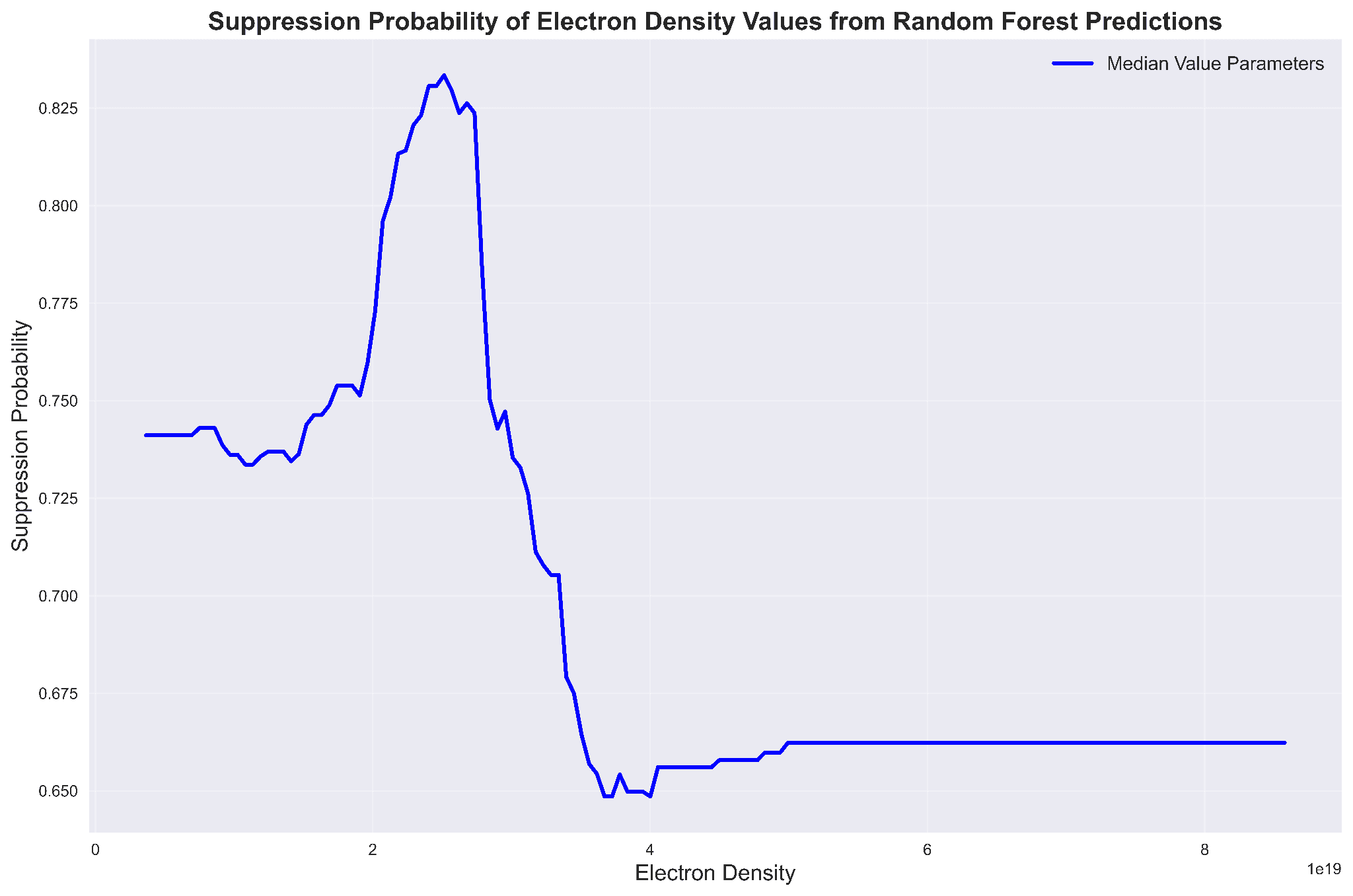
Electron density sweep. With every other parameter fixed at its median, the classifier's suppression probability climbs, peaks around n_e ≈ 2.5×10¹⁹ m⁻³, then falls off sharply above roughly 3.5×10¹⁹ m⁻³. That is the quantitative signature of a density window that the plasma has to sit inside for RMP suppression to hold.
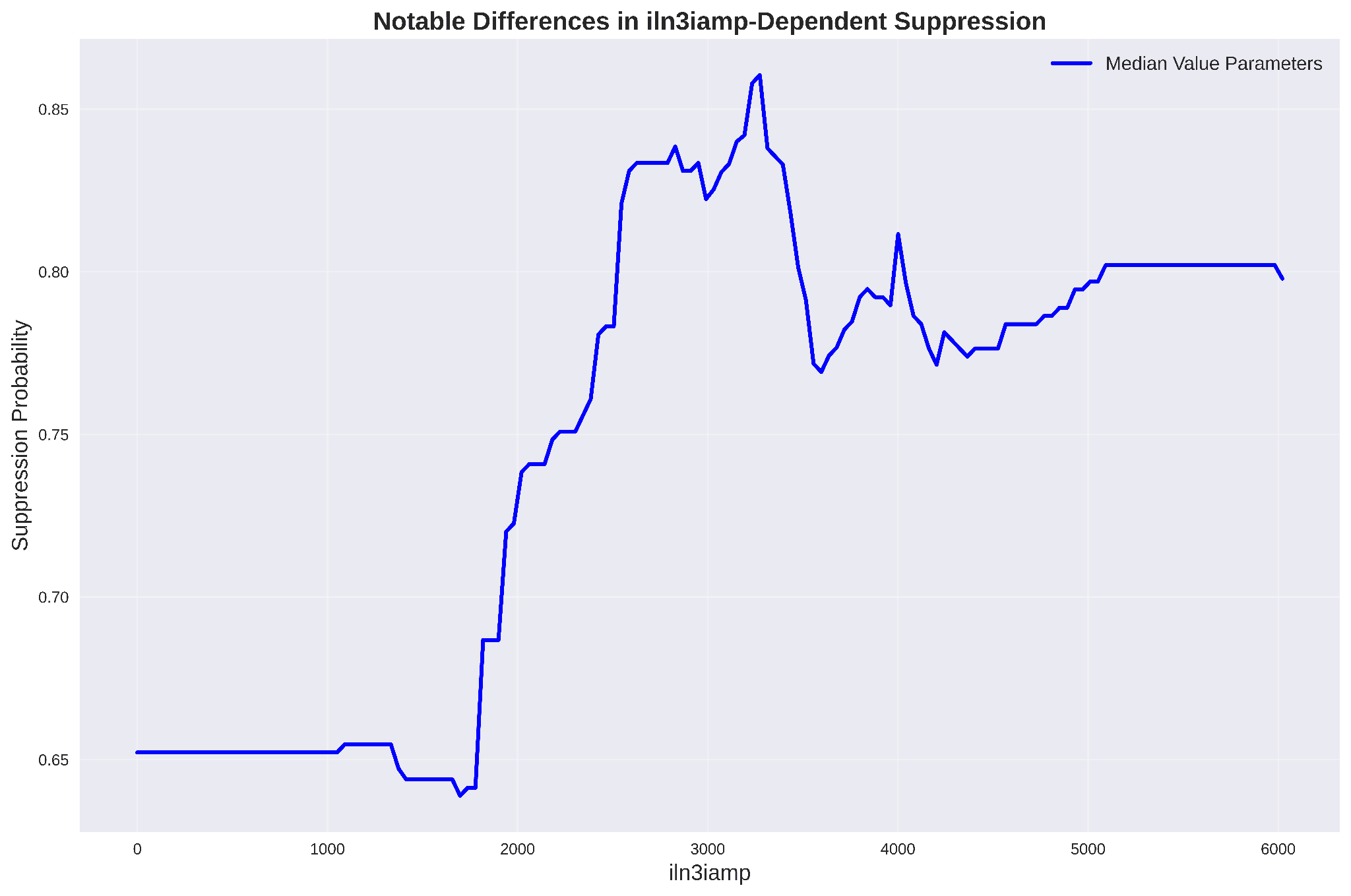
Internal lower coil current-amplitude sweep (iln3iamp). Suppression probability stays flat and low until the coil drive crosses roughly iln3iamp ≈ 2000, then climbs steeply into a plateau near 3000-3500 before softening and re-rising at high drive. That first sharp rise is the coil-drive threshold the group uses to bound safe operating space.
The work complemented the four-state classifier by showing where labels and scalar performance metrics move as hardware setpoints move, not only what class a fixed trajectory belongs to.
Fix medians -> sweep one parameter -> record suppression / stability proxy -> compare to classifier labels on same shots
Results
- Identified eight key thresholds tied to instability suppression when parameters were varied individually in the sweep framework used in the broader ELM project.
- Linked sweep outcomes to manually labeled shot databases so classification and threshold stories stayed aligned.
- Informs safe RMP operating hypotheses for future shots and for comparing model predictions to experimental marginal behavior.
Stack notes
Python, experimental metadata and diagnostic time series, parameter sweep visualization, collaboration with Columbia Fusion Research Center and DIII-D era analysis norms.
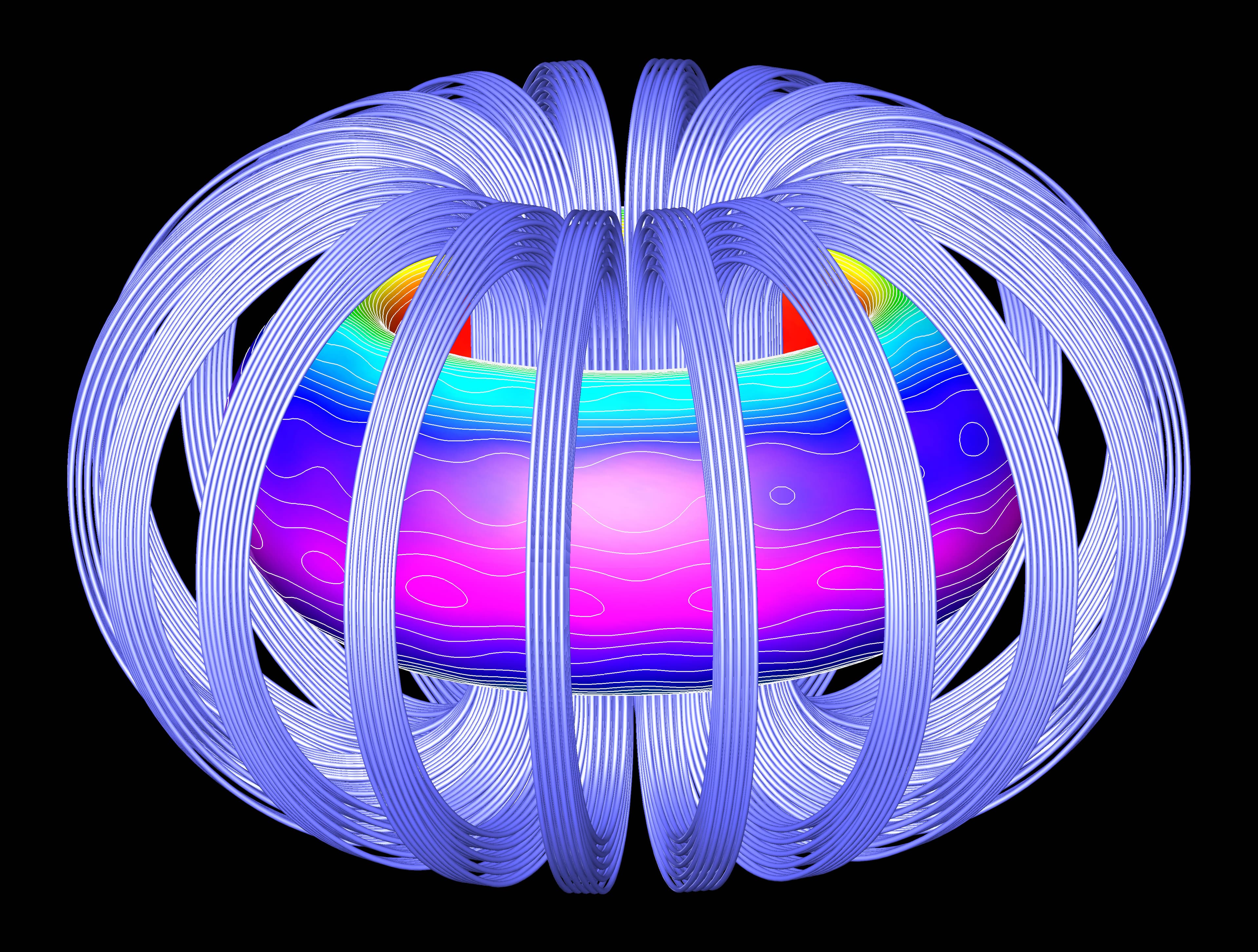
Hero image: ITER 3D plasma equilibrium with ripple contours by Oak Ridge National Laboratory, used under CC BY 2.0. The image shows the ITER plasma surface with toroidal field coils and non-axisymmetric magnetic ripple contours, which is the same class of 3D magnetic perturbation physics the RMP threshold work studies experimentally.
Tech stack
- plasma physics
- RMP
- threshold analysis
- fusion energy